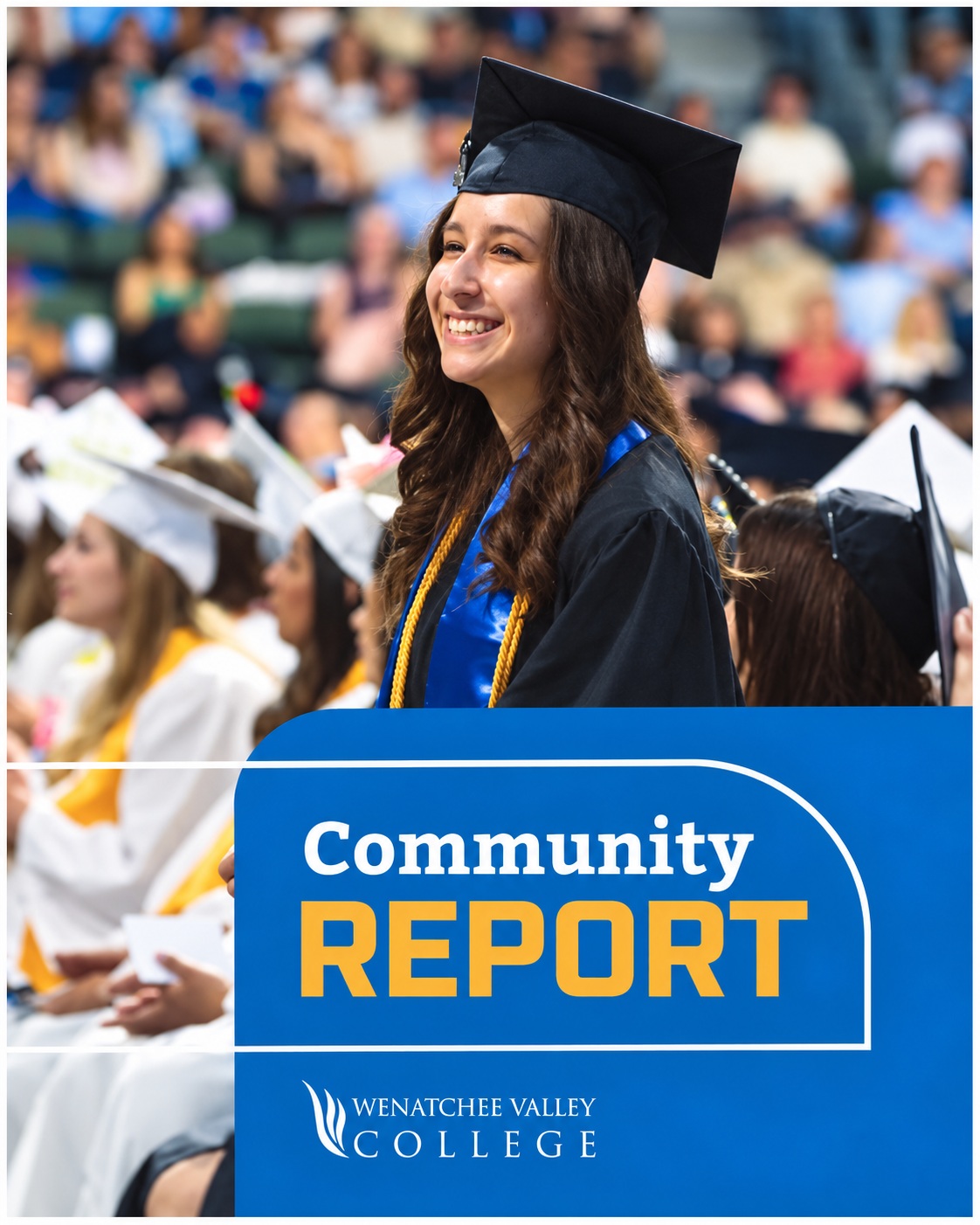
WENATCHEE, Wash. — Wenatchee Valley College has mailed a professionally prepared community report celebrating new programs, student support, workforce successes and a developing culture of excellence. Those accomplishments matter. But the publication tells only one part of the story.
Beyond the glossy presentation is a college confronting an accreditation Warning, weak employee-survey ratings for administrative communication, substantial turnover in executive leadership, controversial private text messages, resignations from its governing board and consequential litigation.
The question is not whether WVC has positive news to share. The question is whether a publicly supported college is giving the communities it serves a complete enough picture of its condition.
A polished report and the numbers behind it
The mailer describes a regional college serving more than 10,000 square miles, with approximately 400 faculty and staff. It celebrates $600,000 in foundation scholarships awarded to 255 students in 2025–26, approximately $800,000 in basic-needs assistance and new academic opportunities, including a behavioral-health bachelor's program.
It also advertises a 79% job-placement rate. But the fine print narrows that figure to a specific group of 2024 workforce-education students: those who completed a workforce certificate or accumulated more than 45 workforce credits. It is not an employment statistic for every WVC student.
There is value in publishing the college's achievements. There is also value in making their definitions, limitations and context clear.
What WVC's own employees said
The most striking contrast comes from WVC's 2025 Personal Assessment of the College Environment (PACE) survey, completed by 159 employees in April 2025. Employees strongly affirmed the importance of their jobs and their work within individual departments. Their evaluations of college-wide organization and communication were markedly weaker.
Read the underlying document: View the complete 2025 PACE employee survey report ↗. Opens a responsive document viewer in a new tab, with an option to download the original PDF.
The survey used a five-point scale. These are average ratings, not percentages.
Source: WVC 2025 PACE report. Bar lengths represent the rating divided by the maximum of 5; they do not indicate the percentage of employees who agreed. Examine the full report ↗
The overall Institutional Structure category received just 2.927 out of 5. By comparison, the Teamwork category averaged 4.007, highlighting the difference between employees' commitment to colleagues and confidence in institutional systems.
Employees appear deeply committed to WVC's mission. Their responses paint a much less flattering picture of how the institution is managed.
Why does a mailer emphasizing a “culture of excellence” provide so little context about the measured concerns of the college's own employees?
A revolving door in executive leadership
Leadership stability is one way to judge the health of an institution. Since President Dr. Faimous Harrison arrived in 2023, WVC has experienced prominent executive changes, including the controversial termination of its chief of staff, the departure of its vice president of Student Affairs, and the resignation of the vice president responsible for organizational culture and Human Resources. Newly obtained personnel records offer a sharper picture of several of those transitions.
Chief of staff terminated after outside investigation
Maria Iñiguez, the president's chief of staff and secretary to the Board of Trustees, was placed on paid administrative leave under a June 25, 2026 letter from Harrison. That letter said the leave was not disciplinary and announced that outside attorney Erin McCool of Ogden Murphy Wallace would investigate text messages involving Iñiguez and trustees Paula Arno Martinez and Wilma Cartagena.
McCool's July 12 investigation report reached specific, but qualified, conclusions. It found sufficient evidence that Iñiguez had improperly shared sensitive internal personnel-conflict information with individual trustees, in violation of WVC Policy 500.100 on ethical employee conduct. It also found that her failure to separate personal friendships from official communications with the board chair and vice chair violated the policy's requirement that employees act independently and impartially.
The report did not find that Iñiguez improperly disclosed confidential information about the Bobbi Johnson settlement or employee exit surveys. It found insufficient evidence that her discussion of petition signatories violated WVC's freedom-of-expression policy, and it did not investigate possible violations by the trustees themselves. The investigator also identified a significant institutional contributing factor: WVC had provided Iñiguez no public-records training or clear guidance on separating personal and professional communications with trustees.
Eight days after the investigator's report, Harrison issued a July 20, 2026 Notice of Termination expressly terminating Iñiguez's chief-of-staff appointment “for convenience (without cause)” under the college's exempt-contracts policy. The letter states that the appointment termination was effective July 31, while also specifying paid administrative leave and continued benefits through August 30, 2026, her last day of employment. The college's personnel separation spreadsheet lists her as terminated on August 30.
That distinction matters: the investigator documented policy violations, while the president elected to use a termination-for-convenience mechanism rather than characterize the separation as a for-cause dismissal. The records establish both facts, but do not explain why Harrison selected that contractual route or whether additional compensation obligations followed.
Read the original document: View President Harrison’s July 20, 2026 Notice of Termination for Maria Iñiguez ↗. The notice expressly states “for convenience (without cause)” and specifies her paid-leave and employment end dates.
The executive responsible for workplace culture explains why she resigned
Lisa Harger, vice president of Organizational Culture and Engagement and the executive overseeing Human Resources, resigned from her executive role with a final employee date of September 11, 2026. Her resignation letter to Harrison is especially relevant to the college's public claims about improving workplace culture.
Harger wrote that her decision reflected months of circumstances in which she felt increasingly unsupported and harassed, and said she could no longer practice human resources in a way she believed upheld her professional values.
“The prevailing culture, the lack of consistent trust, and the absence of decisive and sustained leadership have created a barrier that I am no longer willing to try to overcome.”
Harger also wrote that early progress in the college's Culture of Feedback work had eroded, harming the credibility of the initiative and leadership. Although she praised the employees who had worked on improvement efforts, she said she had lost confidence that senior leadership would consistently support the next phase.
“For months, I have not seen the collective leadership necessary to sustain the progress we have made.”
She described a loss of confidence in whether WVC would back employees who had invested time and trust in improvement efforts:
“I do not want to be the person who asks employees to continue investing in this work when I am no longer confident that the organization will support them in the next phase.”
Her resignation letter also states that the decision was not prompted by a single assignment or dispute:
“This is not about one person, one incident, or one difficult assignment. It is about a pattern.”
Those are not allegations supplied by an anonymous critic. They are the written concerns of the senior executive whose portfolio included the very workplace culture WVC celebrates in its community mailer.
Executive pay for the public-records assignment?
Harger's resignation raises a separate question about the use of public funds. When she accepted the interim executive assignment, she wrote, she had specifically expressed reservations about handling public records and collective bargaining. She later described records processing as work that consumed substantial time and prevented her from performing other duties.
“They consume significant amounts of time, create ongoing stress, and have made me feel that I cannot escape an area of work that I specifically told you I did not want to be responsible for when I accepted the interim assignment.”
Yet, in the same resignation letter, Harger offered to stay on remotely, without Human Resources responsibilities, processing public-record requests until WVC could hire and train a replacement. Her proposed arrangement was explicit:
“I would be willing to perform this work remotely on an hourly contract basis at my current hourly rate, based on the hours actually needed.”
In other words, Harger requested the same hourly rate associated with her vice-presidential position for a narrower assignment centered on public-records processing. That request is documented. The resignation letter alone does not prove WVC accepted that rate or how many hours it approved or paid. Those matters require the transition agreement, payroll records and invoices.
The comparison is no longer hypothetical. WVC has advertised a full-time Public Records & Records Management Officer position, identified as Job Number 2026-00027, with a starting annual salary range of $80,560 to $93,258. The job listing describes on-site work administering the college’s Public Records Act program, coordinating records requests, managing retention and disposition, advising departments and training employees. The advertised duties therefore extend beyond responding to individual records requests. Readers can review the published job listing or WVC’s official employment portal.
By comparison, Harger's former vice-presidential compensation has been reported as approximately $160,000 annually. That reported executive figure is about $66,742 to $79,440 higher per year than the advertised hiring range, although it is not a verified hourly contract rate. A full-time salary with benefits cannot be compared directly with a temporary, hourly arrangement: what matters for taxpayers is the hourly rate actually authorized, the hours worked, the length of the arrangement, and the total amount paid.
The distinction is especially relevant because Harger said the public-records workload was a responsibility she had not wanted, yet proposed remaining to do that very work at her existing hourly rate after leaving the vice-presidential position. The college may have had a legitimate need for experienced interim coverage during recruitment. But the existence of a posted, substantially lower-paid specialist position makes a documented explanation of the pay decision all the more important.
WVC publicly advertised a full-time public-records position paying $80,560–$93,258 annually. Did the college nevertheless approve Harger's request to perform transitional public-records work at her former executive hourly rate? If so, who authorized it, what business justification was documented, how does the rate compare on an hourly basis with the posted position, and what has actually been spent? The signed agreement, time records and payments would answer those questions.
Harger wrote that roughly 30 public-record requests were open at the time of her resignation. The college has a legal obligation to respond to records requests, and continuity during a staffing transition may have value. Whether paying a former executive's requested hourly rate was reasonable, however, is a separate question that the available letter does not settle.
Additional administrative departures
Dr. Diana Garza, vice president of Student Affairs, also departed the college's senior leadership. The materials examined for this update do not establish her stated reason for leaving, and no particular motive should be attributed without her resignation or separation records.
More high-level departures documented since January 2023
The personnel separation spreadsheet obtained with the resignation records identifies a larger group of former executives, directors and administrators. WVC says Harrison took office on January 3, 2023. The entries below occurred after that date. They are not all members of the president's cabinet, and a departure does not establish that the employee left because of Harrison or because of workplace conditions.
| Former employee | WVC position | Separation recorded |
|---|---|---|
| Joanna Tepley | Budget analyst / ctcLink analyst; previously budget analyst and internal-controls accountant | Resigned, March 31, 2023 |
| Libby Siebens | Executive director of Community Relations | Resigned, July 13, 2023 |
| Cynthia Requa | Executive director of ASPIRE (assessment, strategic planning, institutional research and effectiveness) | Resigned, February 15, 2024 |
| Pedro Navarrete | Associate vice president of Strategic Enrollment and Community Partnerships | Resigned, March 15, 2024 |
| Reagan Bellamy | Executive director of Human Resources; previously public-records officer | Recorded as fired, September 30, 2024 |
| Joe Eubanks | Executive director of Climate, Culture, Diversity and Belonging; Title IX/EEO coordinator | Resigned, January 30, 2025; spreadsheet lists another job |
| Brian Kortz | Director of Athletics, Exercise Science and Recreation | Recorded as terminated, September 10, 2025 |
| Rachel Evey | Executive director of the WVC Foundation | Resigned, September 30, 2025; accepted a new position |
| Brett Riley | Vice president of Administrative Services | Recorded as terminated, October 3, 2025 |
| Ryan Lamb | Interim director of Fiscal Services | Resigned, October 21, 2025; spreadsheet lists another job |
Dr. Robin Angotti is another senior departure. WVC appointed her director of ASPIRE and its accreditation officer in July 2024. The outside investigation into Iñiguez's texts recounts her abrupt resignation during a cabinet meeting in 2025, according to Iñiguez's interview; however, that report does not itself supply an independently verified personnel-separation date. The college's announcement of Angotti's appointment describes her accreditation and institutional-effectiveness responsibilities.
Athletics offers another visible example of turnover. WVC announced Brian Kortz's appointment in July 2024. Its personnel spreadsheet records his termination in September 2025. WVC then named Levi Vega acting athletic director that September, before announcing Greg Sparling as director in December 2025. Those records show a permanent-director transition and an interim appointment, not an independently verified tally of multiple athletic directors being fired.
The distinctions are important: the spreadsheet labels some separations as resignations, others as terminations or fired, but generally does not describe any investigative findings or the circumstances behind dismissals. Rachel Evey's next job, for example, was publicly celebrated by WVC. Pedro Navarrete later joined Yakima Valley College as a vice president. This is a record of personnel churn, not proof that all those individuals experienced the same workplace conditions.
Source documentation: WVC personnel separation spreadsheet titled Resignations 2023 to present - 647-082626.xlsx, provided with responsive resignation records, cross-checked against WVC publications, institutional board records and public employment histories. The spreadsheet records employment actions, not a complete account of why each person left.
Other documents identify additional changes below the cabinet level. WVC's personnel spreadsheet records the August 14, 2026 resignation of Ellia Sablan-Zebedy, dean of Strategic Enrollment and Student Success, with another state job listed as the reason. A separate letter from Dani Fisher, interim assistant HR director, says she resigned effective August 14 after receiving an unexpected career opportunity; she praised WVC's employees and her HR colleagues. As Fisher put it, “Like any organization, the College has its challenges, but without question, WVC's greatest asset is its people.”
A resignation dated August 5 from WVC Foundation communications specialist Samantha Vedders offers a different explanation for leaving: “I am pursuing another career opportunity that has offered me a more suitable wage than I am able to obtain here at the Foundation.” The letter does not attribute her departure to the college's culture or senior leadership. Taken together, these firsthand statements underscore that not every departure had the same cause, even as WVC faces broader questions about retention.
Questions about potential turnover extend beyond executive positions. Sources described to the WVC Blog as insiders say Maggie Segesser, WVC's registrar, was planning to leave the college and attribute that reported decision to frustration with what they call a “toxic workplace.” The Blog has not confirmed whether Segesser has resigned or departed, when any departure might occur, or her reasons. The “toxic workplace” description reflects the sources’ characterization, not a verified statement from Segesser.
The Concerned for WVC website has reported approximately 110 full-time employee departures since Harrison's arrival. A college personnel spreadsheet accompanying the newly obtained letters lists dozens of departures across 2023, 2024 and 2025–2026, but includes resignations, retirements, terminations and position or funding changes. Because the periods and personnel categories vary, its rows should not be treated as an independently verified full-time turnover rate without further reconciliation. The community report's approximately 400 faculty and staff also refers to a broader workforce than the approximately 250 full-time workers used in the outside website's analysis.
How many members of Harrison's original cabinet remain? What did vacancy periods, executive recruitment, paid leave and separation agreements cost? The newly obtained letters document significant turnover and some of its stated causes, but do not establish a complete original-cabinet attrition count.
What these records do establish is more consequential than an unsupported headline number: important departures occurred for different reasons, and one of the college's most senior officials responsible for cultivating a healthy workplace resigned while explicitly questioning the institution's trust, culture and leadership follow-through.
The text-message controversy and two trustee resignations
In July 2026, the WVC Blog published public-record text messages involving Iñiguez and trustees Paula Arno Martinez and Wilma Cartagena. The exchanges prompted questions about professionalism, board independence and private commentary involving college leadership.
On July 27, 2026, WVC announced that both trustees had resigned voluntarily, effective immediately. The resignations followed scrutiny of the texts. The college did not state that the controversy caused their decisions, and the temporal sequence should not be mistaken for proof of motive.
Nevertheless, the termination of the chief of staff and the departure of two members of the institution's governing board in the same period are significant governance events that a complete account of the college's current circumstances ought to confront.
Explore the blog's public-record investigations for reporting on the trustee communications, leadership relationships and the circumstances surrounding these departures.
The union president's question: “100% honest”?
An additional public-record exchange came from Micky Jennings, president of the faculty Association for Higher Education, and Jennifer Hadersberger, a cabinet-level administrator. As WVC faced accreditation review, Jennings asked whether he was supposed to be completely honest or partly say what was needed to protect jobs.
“during these meetings, am I supposed to be 100% honest, 90% honest 10% optimistic, or 50% honest 50% say what needs to be said to save our jobs ... ?”
Importantly, Hadersberger's response encouraged honesty: “Good question-yes honest.” She also urged Jennings to discuss observed improvement work. The messages do not prove he misled accreditors, nor that administrators asked him to do so.
But the question itself is striking for an elected faculty representative speaking with college leadership while its accreditor was reviewing institutional practices. Read the full investigation and the linked source messages.
Accredited, but under a public Warning
WVC remains accredited by the Northwest Commission on Colleges and Universities. That important distinction should not be lost. But the accreditor's public directory also identifies the college as operating under a Warning sanction.
WVC announced the reaffirmation of its accreditation in August 2026 while acknowledging further work was necessary. Its accreditor identifies a spring 2026 evaluation and a spring 2027 ad hoc review.
Remaining accredited and continuing under Warning are not contradictory facts. Both are necessary for readers to understand the college's status.
Read the NWCCU institutional directory and WVC's August 2026 announcement.
A $1 million harassment settlement and another lawsuit pending
WVC has also faced major legal challenges. In June 2025, NCWLife reported that Wenatchee Valley College reached a $1 million settlement with science professor Bobbi Johnson over harassment claims. This was a settlement, not a jury award or a court verdict establishing liability. The case and its substantial reported cost are relevant to a community discussion about workplace culture, management and public accountability. Read NCWLife's report on the Bobbi Johnson settlement ↗.
The college is also defending a separate pending federal civil-rights lawsuit alleging retaliation and due-process violations. Those allegations remain contested, and a pending claim is not a judicial finding that wrongdoing occurred.
Yet major employment litigation and a pending civil-rights case are relevant context when the college is promoting the strength of its management and organizational culture. Readers may reasonably ask about the financial consequences, legal costs, corrective measures and oversight associated with each case.
Transparency is tested by uncomfortable records
In August 2026, the blog reported that a WVC senior auditor–budget analyst acknowledged a practice of deleting text messages at the end of the business day. Separate recovered messages included college-related financial discussions.
That practice raises questions about record-retention procedures and compliance with Washington's Public Records Act. It does not, on its own, prove a court-adjudicated violation or establish that every deleted text was a public record subject to retention.
The point is larger than any single text: transparency is measured not only through what an institution elects to publish, but through how it preserves and discloses records that may be inconvenient.
Does leadership training prove a culture of excellence?
The community report highlights WVC's Leadership Development Academy, including 19 graduates in June 2026. Such programs can be valuable to the employees who participate.
But their success ultimately depends on the institution's results. Has internal communication improved? Have employees gained confidence in procedures and decision-making? Has executive turnover slowed? Will the next PACE survey show measurable gains?
Until those questions are answered, a leadership academy is evidence of an initiative, not proof that the underlying leadership problems have been solved.
What did the mailing cost?
The publication carries an Every Door Direct Mail postal marking, but the document itself does not establish exactly how many copies were mailed, which communities received them, or how much the campaign cost.
Those are legitimate public-record questions: What did design, translation, printing and postage cost? Who approved the campaign, and which funding source paid for it?
There is nothing inherently improper about a college sharing success stories with its service area. The question is whether publicly supported communication should give residents a sufficiently balanced understanding of the college's circumstances.
What remains beneath the frosting?
Wenatchee Valley College remains a vital institution. Faculty, staff and students continue to do work worth celebrating. The PACE survey itself demonstrates a powerful commitment to the educational mission even among employees concerned about administration.
But the institution's challenges cannot simply be omitted from the public conversation because they do not fit the theme of a community mailer.
Readers deserve to know about student scholarships and a continuing accreditation Warning; new programs and employee concerns; leadership development and leadership departures; institutional successes and the outcome of major lawsuits.
The most troubling feature of the community report may not be what it says. It may be what it leaves unsaid.
A fresh layer of frosting may make a troubled cake look appealing. But the public deserves to know what is underneath.
Sources and editorial notes
Primary materials: WVC's October 2026 mailed community report; WVC 2025 PACE employee survey; public-record text messages and earlier reporting available at Wenatchee Valley College Blog News; WVC announcements; and NWCCU's institution directory. full 2025 PACE report.
Context and limitations: The website Concerned for WVC includes anonymous testimonials and turnover estimates not independently verified in this article. Reported lawsuits and investigations are distinguished from adjudicated findings. This article does not assert that executive departures or trustee resignations were caused by any specific event in the absence of such evidence. The Bobbi Johnson matter is described as a $1 million settlement based on NCWLife’s June 2025 reporting; this article has not independently examined the executed settlement terms or allocation of payment. The reasons for departures not explained in source letters and the original-cabinet attrition count require further documentary confirmation. The independent Iñiguez investigation and the without-cause termination letter are now available and are described above. Harger’s request to continue records processing at her prior hourly rate is documented, and the public-records officer hiring range of $80,560–$93,258 is supported by a published WVC job advertisement. The college’s acceptance of her proposed rate, actual hours and payments remain unverified; reported annual executive compensation is not equivalent to a verified hourly contract rate.
Right of reply: WVC leadership, the people discussed in this article and other parties with relevant first-hand evidence are welcome to provide corrections, records and responses. Contact info@wenatcheevalleycollege.com.